

How a town is drawn
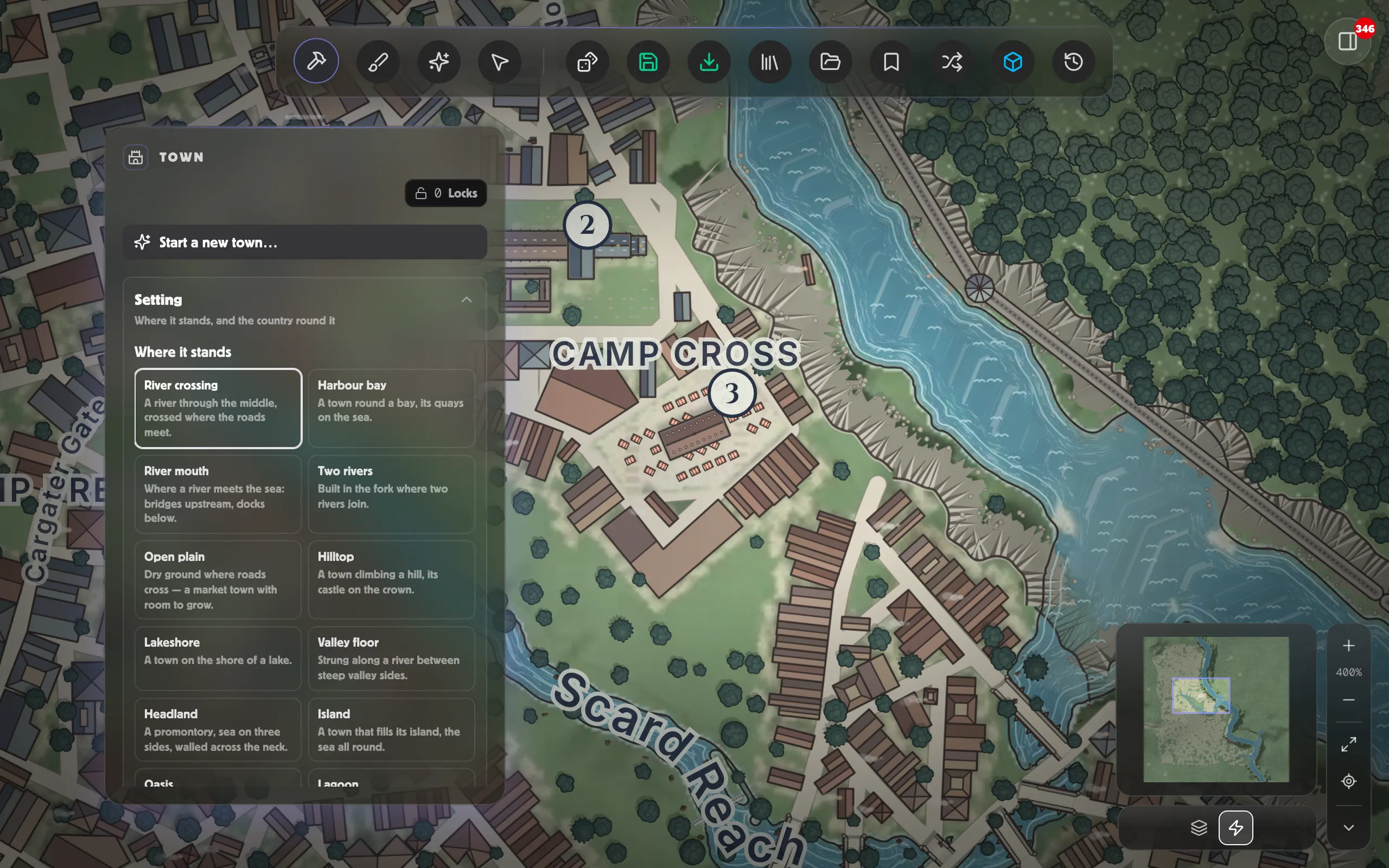
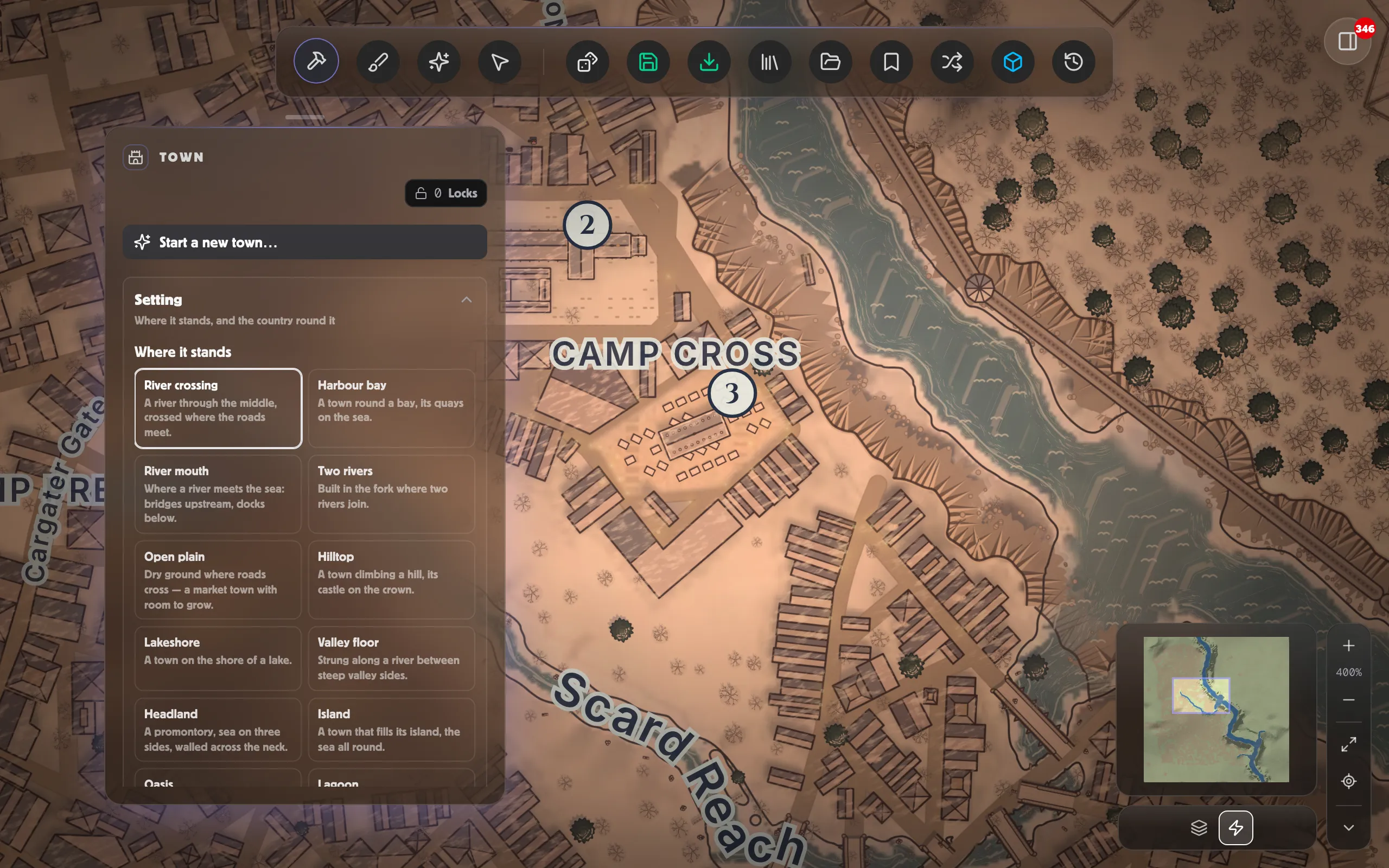
A town is drawn the way a village is, close to: roofs that take the sun on one pitch and fall into shade on the other, each casting its shadow; paved streets; yards of beaten earth round the houses and gardens behind them; the market square laid in stone; woods drawn tree by tree; the river or the sea with its banks and shore. Its curtain wall stands round it with its towers and gatehouses.
The country round it keeps the lie of its land. Slopes away from the sun fall into shade and the scarps along a river show dark, the high ground is a little drier and paler, and the town’s open fields are laid out in their strips. Where the ground falls steeply (a river’s bluffs, a valley’s walls, a hill’s flanks), the map draws its cliffs as broken rock with scree at their foot, and its steep banks as turf combed with hachures. A lane that comes to the edge stops at the top; a street that runs down to meet another goes through, in a cutting.
At full extent a city’s houses are only a few pixels across. Zoom in, or export larger, to read every roof.
Look, time and weather
Section titled “Look, time and weather”Under Style a town takes the same list of styles as every map — the ones made for towns and villages first, then the ones made for regions. See Village looks. Its season, time of day and weather are the map’s Sky: the pill in the toolbar, or the Sky row under Style. The style marked This map is the town’s own, so an Atlas town has Atlas colours and a Parchment town is inked on parchment; picking another never renames the town’s streets or places.
A town in tropical country, by a river or inland, is drawn in the jungle: red-earth streets, thatched houses and rainforest round it.
In the live preview it moves: the trees sway, smoke rises from its chimneys, the river runs, and as the hour turns the shadows swing round its houses and walls. By night its windows light up one by one, lanterns line its high streets and braziers burn at its gates.
In winter the snow lies on its roofs, lit on one pitch and blue in the shade of the other, and its streets are trodden to slush, so the plan still reads from a distance. An oasis town grows palm groves along the shore of its pool.
Roof material is normally Mixed, drawing on whatever the tradition uses (a medieval town is thatch with tile and slate through it). Force a single material for a planned settlement where everything went up at once. To change one house’s roof, select it with the Edit tool; see Editing a town.
Hiding parts of the town
Section titled “Hiding parts of the town”The Layers panel switches parts of the map off: the ground, the fields, the water, the roads and streets, the buildings, the trees, the life (smoke, birds, weather) and the names. Each switch hides that part in the preview and in anything you export. Switching off Buildings takes their shadows with them.
A town drawn in ink is line work of its own, so its switches are its streets, its buildings and its walls, each leaving its own lines out.